THE trail began with cocaine. Six weeks before Thai police smashed what investigators are describing as a sophisticated AI-assisted romance scam ring, a routine narcotics operation in April netted a Nigerian national identified only as Patrick, along with three associates. Officers seized assets worth 2.5 million baht. When they followed the money, it took them to a high-end condominium complex on the banks of the Chao Phraya River, near Phra Nangklao Bridge — and to a cluster of foreign nationals living five or six to a unit, none enrolled in school, none in gainful employment, all in possession of student visas.
What police discovered inside those three units on Thursday, 22 May, was a blueprint for industrialised heartbreak.
The Raid
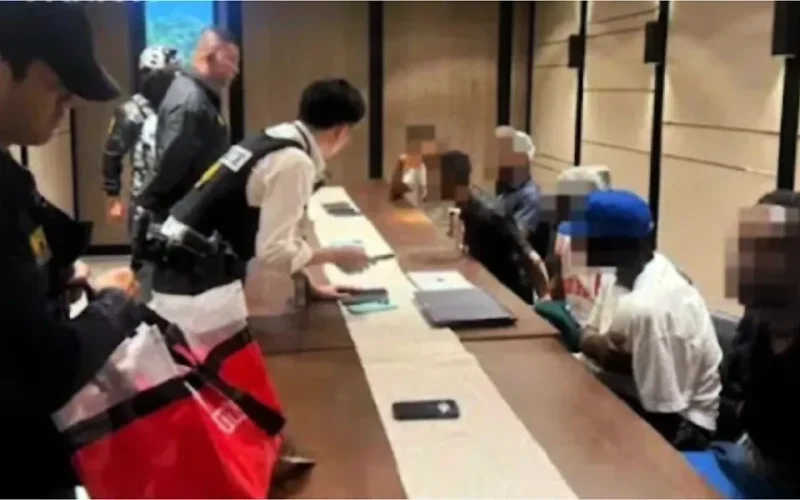
Executing three simultaneous search warrants, officers forced entry after the suspects refused to open their doors. The scene that greeted them spoke to both the sophistication and the panic of those inside. One man attempted to clamber over a balcony. Another was found face-down on a bathroom floor, phone in hand — texting warnings to the other units as police moved through the building.
Officers seized 18 mobile phones, three laptops, and three bank passbooks. The phones were still open to active romance scam chat threads at the time of arrest.
“A single well-crafted line could convince a victim to empty her account.”
Thai Police investigators
The Architecture of Deception
The ring operated with alarming precision. Using AI-generated images of Western men — rendered in sufficient detail to pass muster on video calls — the suspects constructed elaborate false identities: commercial airline pilots, United States military officers, physicians, and engineers. These personas were deployed systematically against older Thai women on dating platforms and social media.
Investigators recovered AI-generated face composites used to produce fake video calls, evidence that the operation had moved beyond simple catfishing into the weaponisation of generative AI for financial fraud. They also found “sexy chat” scripts — written dialogue designed to manufacture emotional intimacy and lower victims’ financial defences — crafted specifically to push women toward making bank transfers.
The classic endgame was a fabricated customs crisis: a valuable package, notionally sent by the fictional partner, ostensibly detained at a Thai port or airport, and requiring an urgent transfer fee to secure its release. Police said the scripted preamble was so precisely calibrated that a single well-worded message could persuade a victim to drain her account.
Six in Custody; Wider Charges Pending
All six suspects — Nigerian nationals — face initial charges under Section 209 of the Thai Criminal Code, the provision governing illegal association (อั้งยี่), as well as immigration overstay. Fraud charges and formal romance scam indictments are pending as investigators work through the seized devices and financial records.
The use of the อั้งยี่ statute, historically applied to organised criminal gangs and triads, signals that Thai authorities are treating the operation as structured organised crime rather than individual opportunism.
A Continent’s Reputation, a Region’s Vulnerability
The arrests arrive at a delicate moment. Across Southeast Asia, law enforcement agencies have spent the past two years dismantling industrial-scale fraud compounds — most notoriously in Myanmar’s Kokang and Shan State border zones, where tens of thousands of trafficked workers, many from Africa, have been coerced into running romance scams and cyber fraud at gunpoint. The Thai case is smaller in scale but structurally similar: organised, scripted, technologically augmented, and predatory by design.
For African diplomatic missions in the region, the arrests represent an ongoing reputational challenge. Nigerian authorities have for years pressed partner governments to distinguish between the vast majority of law-abiding Nigerian expatriates and the criminal networks that exploit the Nigerian passport’s global reach. That distinction rarely survives a headline.
The case also underscores the accelerating democratisation of AI-assisted fraud. What once required specialist knowledge — convincing voice synthesis, real-time face-swapping, documentary fabrication — is now available to anyone with a laptop and a subscription. The barrier to entry for romance fraud, already low, has effectively collapsed.
| “The phones were still open to active romance scam chat threads at the time of arrest.” |
Investigation Continues
Thai police have not disclosed the total estimated value of the fraud or the number of victims identified thus far. Financial forensics on the three seized passbooks and 18 devices are ongoing. Investigators are expected to apply for asset freezing orders as the full picture of the operation’s proceeds emerges.
The April cocaine arrest that set the investigation in motion — and the four individuals detained then — remain subject to separate trafficking proceedings. Whether those cases and the romance scam ring are formally linked in a single prosecution has not been confirmed.