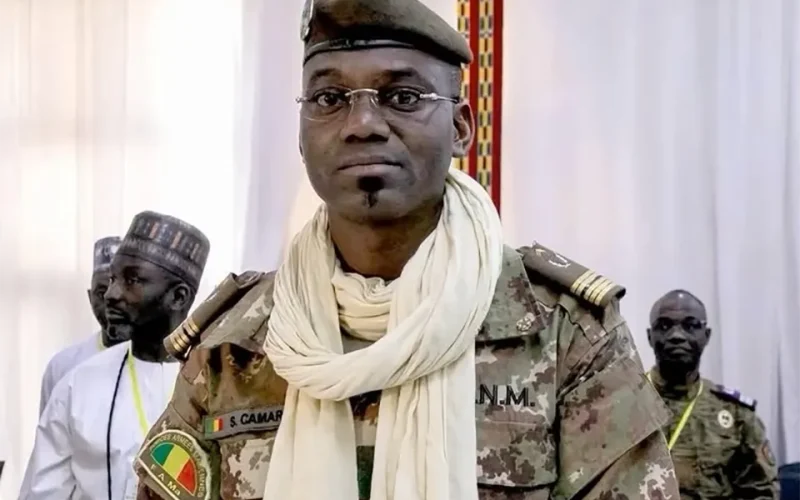
MALI’S Defence Minister Sadio Camara has been killed in a car bomb attack on his home in Kita, near Bamako – a assassination that strikes at the very heart of the military junta and shatters any remaining pretence that the country’s worst security crisis in years is under control.
Family members confirmed that Camara, his wife and two grandchildren died in the blast, elevating Saturday’s coordinated insurgent assault from a spectacular operational strike to something far more politically devastating: the decapitation of the junta’s security leadership on its own soil, in its own backyard.
The killing lands like a thunderclap on a government that had spent the previous 24 hours urgently insisting it had repelled the attacks and restored order. Government spokesman Issa Ousmane Coulibaly told state television on Saturday evening that the situation was “completely under control in all affected areas.” Camara’s death on Sunday rendered that statement not merely premature, but a monument to official denial.
The coordinated strikes that began before dawn on Saturday were already extraordinary in ambition and execution. Al-Qaeda affiliate Jama’at Nusrat al-Islam wal-Muslimin (JNIM) claimed attacks on the Bamako international airport, the Kati military barracks, and multiple northern towns including Mopti, Sévaré and Gao. The Azawad Liberation Front (FLA), a Tuareg rebel coalition, simultaneously claimed it had seized Kidal. Residents of Sévaré described gunfire coming from all directions. Passengers attempting to reach Bamako’s airport found themselves at the edge of active combat.
And now a cabinet minister is dead. His wife and grandchildren with him.
Heni Nsaibia, senior West Africa analyst at the Armed Conflict Location and Event Data Project, had already noted that the selection of targets was “remarkable” — aimed precisely at places central to the regime’s narrative of control. Kidal, retaken by Malian and Russian Wagner forces in 2023 in what the junta presented as proof of restored sovereignty, has now been claimed again by the FLA. Rebel spokesman Mohamed Ramdane announced on Sunday that an agreement had been reached for Malian and Russian-backed forces to withdraw — an extraordinary claim that, if confirmed, would mean the 2023 reconquest has been reversed in a single weekend.
“Fighting resumed in Kidal this morning,” Ramdane said. “We want to drive out the last Russian fighters who have taken refuge in a camp.”
Across the country, the second day of violence mocked the government’s reassurances. Fresh fighting was reported in Kidal, Gao and Sévaré. Residents in multiple cities described fear and trauma in the aftermath of explosions and sustained gunfire. A three-day overnight curfew imposed on Bamako did little to arrest the psychological damage. The airport, closed through Saturday, remained a symbol of a country under siege rather than a government in command.
For Alioune Tine, founder of the Afrikajom Centre, the unfolding events expose a governance failure of historic proportions. “If Mali falls, the whole Sahel will follow,” he warned – and the killing of the defence minister gives that warning new and terrible weight. The junta that seized power in coups in 2020 and 2021 built every claim to legitimacy on a single premise: that soldiers would deliver what civilian politicians could not. Security. Territorial integrity. Stability. Each of those claims is now in question simultaneously.
The Russian dimension adds a further layer of strategic complexity. The junta expelled French forces and United Nations peacekeepers in favour of Wagner Group fighters, rebranded as the Africa Corps. Those Russian fighters were embedded in the operations that retook Kidal. Now, if rebel accounts are accurate, they are withdrawing under rebel pressure — or negotiating their exit. In a studied signal on Saturday, JNIM declared it had deliberately not targeted Mali’s Russian partners and expressed interest in a “balanced and effective future relationship.” Moscow condemned the attacks as “cowardly” and — without evidence — alleged Western involvement in insurgent training. The information war is running alongside the shooting war.
But no amount of information management can absorb the political weight of what has happened. A sitting defence minister, killed at home. A northern city, lost again. A government’s security narrative, dismantled in 48 hours.
Goïta’s junta is no longer fighting merely to restore order. It is fighting, with diminishing credibility, for its own survival. And the outcome of that battle – with consequences that will radiate across the Sahel’s fragile constellation of collapsing states – is no longer remotely certain.