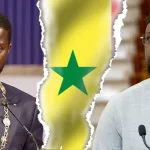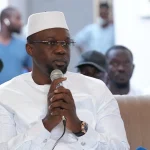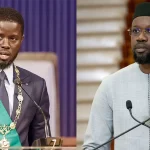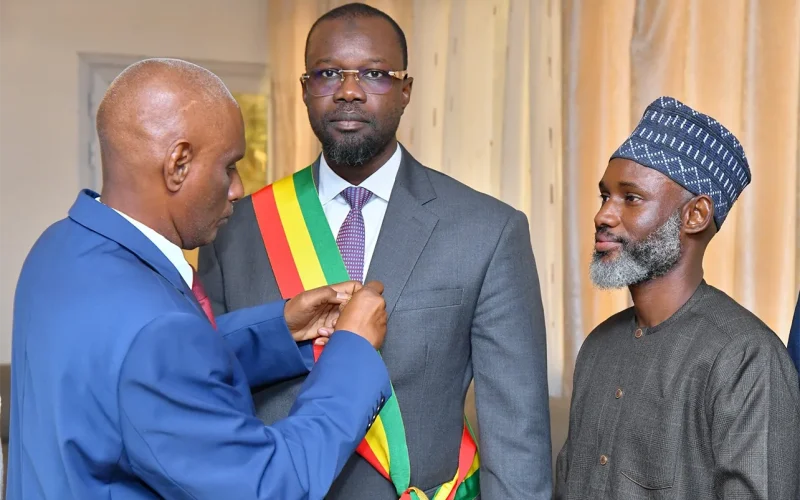
THE battle lines in Senegal’s deepening political crisis have been firmly and irrevocably drawn. In a stunning turn of events that has reshaped the republic’s constitutional landscape almost overnight, Ousmane Sonko was sworn in as President of the National Assembly on Tuesday – barely 48 hours after President Bassirou Diomaye Faye dismissed him as Prime Minister. On the same day, Faye moved to fill the executive vacuum by swearing in a new premier, Ahmadou Al Aminou Lô, in a parallel ceremony at the presidential palace. Senegal now has two power centres, and the man at each one is determined to prevail.
The scenes inside the National Assembly were extraordinary. Deputies from Sonko’s PASTEF party – which commands an overwhelming majority in the chamber – erupted in celebration and dance as their leader took his seat at the head of parliament. The jubilation was not merely partisan; it was the sound of a political resurrection. A man who had been removed from the executive by presidential decree had, within two days, claimed the second-highest office in the land through the democratic will of the legislature.
“There will be no system of hyper-presidentialism in Senegal today.”
Ousmane Sonko, President of the National Assembly
Sonko’s inaugural address was anything but ceremonial. It was a declaration of political intent, framed in the language of constitutional principle but pointed with unmistakable precision at the man who fired him.
“There will be no system of hyper-presidentialism in Senegal today,” Sonko said, to thunderous applause. He cast the new configuration of power not as personal vengeance but as a moral and democratic imperative. “What is at stake is the relationship between morality and politics,” he declared – a phrase that resonated through a chamber well aware that the man delivering it had himself been a symbol of anti-establishment revolt before finding himself inside the establishment he once confronted.
He moved quickly to define the terms of his speakership. “The National Assembly will use all its levers of power firmly but responsibly moving forward,” he warned, signalling that parliament would not be a passive institution under his watch. But he was equally emphatic about the limits of his ambition. “I will not use the Assembly to feed personal vendettas. That would be a betrayal to our very own struggle” – a line that served simultaneously as a pledge of restraint and a reminder of the revolutionary credentials that brought him here.
“You cannot have PASTEF without PASTEF.”
Sonko, on the appointment of the new Prime Minister
The most pointed section of his speech concerned the appointment of the new Prime Minister, Lô – a process Sonko described as a unilateral executive act that bypassed the ruling party entirely. “Our party was not involved in this decision to appoint the new prime minister. It was also not consulted in the formation of the government,” Sonko said bluntly. “You can’t have PASTEF without PASTEF.” The line was both a rebuke of Faye’s governing style and a statement of future intent: that PASTEF, as the dominant parliamentary force, will demand a central role in the direction of government – regardless of who occupies the prime ministerial office.
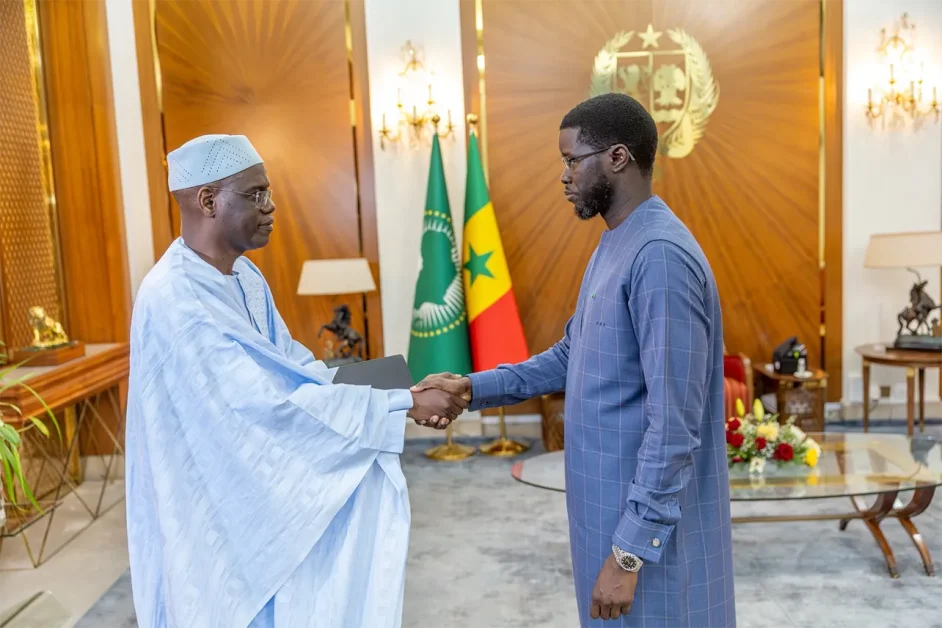
Sonko acknowledged knowing Lô personally, noting that the new premier had “accomplished a tremendous amount of work” during the year and a half they worked together. But he did not spare him from scrutiny. He said he held “certain disagreements” with Lô on monetary and debt-related issues – a signal that the new prime minister should expect no easy passage through a parliament where Sonko sets the agenda and controls the numbers.
While insisting that PASTEF would give President Faye “the best conditions to complete his term,” Sonko’s framing of that pledge contained its own implicit threat. Completion of a term is not the same as freedom of action. A president who must legislate through a hostile Speaker, whose budget must pass through a parliament his former ally controls, and whose every appointment can be interrogated and obstructed, is a president constrained in ways the constitution permits but political survival cannot easily absorb.
For Faye, the situation is without precedent in modern Senegalese history. He came to power on the back of a movement Sonko built, was swept into office on a wave of popular legitimacy the two men shared, and now finds himself facing that same force from across the constitutional divide. His new Prime Minister, Lô, enters office with the full authority of a presidential appointment – and the immediate task of navigating a legislature whose Speaker has already declared the terms of engagement.
The chess game that began with Sonko’s dismissal has reached its first decisive position. The king moved. The kingmaker responded. And now, with both men entrenched in the institutions of the republic, the real contest begins – not in the streets, not in the courts, but in the grinding daily business of governance, legislation, and power.
Faye retains the presidency, the executive, and the instruments of state authority. But he must now defend them – every day, on every front – against a Speaker who has an overwhelming majority, a fiery mandate, and absolutely nothing left to lose.