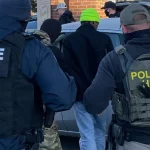
THE early morning knock came without warning. Federal agents from Immigration and Customs Enforcement stood at the door of a St. Paul home, demanding entry. Inside was a Somali woman with permanent legal status to remain in the United States. For three hours, she scrambled to prove her right to be in the country she had called home for years, her hands trembling as she searched for documents while armed officers occupied her living room.
This scene, recounted by Minneapolis immigration attorney Amiin Harun, has become increasingly common across Minnesota as the Trump administration intensifies what it describes as a targeted enforcement operation against East African immigrants. The crackdown has sent waves of fear through communities that have spent decades building lives in America, while a parallel effort targets Kenyan nationals through a controversial new public database.
“Their Country Stinks”: Presidential Rhetoric Fuels Enforcement
The escalation began with President Donald Trump’s comments during a Cabinet meeting on December 2, when he singled out Minnesota’s Somali community with language that shocked even seasoned political observers.
“I don’t want them in our country; I’ll be honest with you,” Trump declared. “Their country is no good for a reason. Their country stinks. And we’re going to go the wrong way if we keep taking in garbage into our country.”
The president’s remarks came as federal authorities prepared immigration enforcement operations in Minnesota, home to roughly 87,000 Somali residents – the largest such population in the United States. Treasury Secretary Scott Bessent amplified concerns by announcing an investigation into whether taxpayer funds may have been diverted to the terrorist organisation al-Shabab, though federal prosecutors have not charged any defendants with material support to foreign terrorist organisations.
For Minneapolis Councilman Jamal Osman, who is of Somali descent, the president’s words cut deep.
“The fear of having the entire nation just look and see us, and look at us as garbage and less human,” Osman said, his voice heavy with emotion. “No human is a garbage.”
Communities Under Siege
ICE agents have arrested at least 12 people in Minnesota enforcement operations, according to reports from early December. Of those detained, five are from Somalia, six are Mexican nationals, and one is from El Salvador. But the impact extends far beyond those arrested.
Osman told reporters that ICE has targeted English as a second language courses, places of worship, and private homes. The dragnet has ensnared not only undocumented immigrants but also individuals with social security numbers and work permits, those awaiting asylum interviews, and even U.S. citizens caught in the enforcement sweep.
“People are afraid to leave their houses,” Osman said. He now advises community members of Somali descent to carry their passports everywhere—a precaution that feels dystopian in a country built on immigrant dreams.
“I never knew there will be a day that you have to show your legal document in the United States because you look Somali,” he said. “But the reality is people are not leaving home without their passports.”
Minneapolis Mayor Jacob Frey condemned the operations as efforts to terrorise residents rather than enforce immigration law.
“We have received reports about a number of scattered incidents in which federal agents were involved in some form of activity,” Frey said at a news conference. “In many cases, those activities are largely built around terrorising people.”
The Kenyan Connection: A Database of Shame
While Minnesota’s Somali community faces raids and arrests, Kenyan nationals across the United States find themselves listed on a controversial new Department of Homeland Security platform dubbed the “Worst of the Worst.”
The database, launched under direct orders from President Trump, publicly displays the names, mugshots, countries of origin, and criminal charges of individuals arrested by ICE. Fifteen Kenyan nationals convicted of various crimes in the United States are slated for deportation and appear on the platform, which DHS says will eventually provide access to hundreds of thousands of immigration cases.
“The platform is a key step in fulfilling the president’s commitment to removing dangerous criminals from the country,” said DHS Secretary Kristi Noem at the launch.
The database focuses on serious felonies, including violent crimes, sexual offences, gang affiliation, drug trafficking, and organised crime. Officials say it is designed to increase transparency and justify the speed and scale of enforcement operations.
But for families in Nairobi who depend on remittances from relatives in the United States, the public shaming carries consequences beyond deportation. Advocates warn that the listing of offenders by name and face could endanger family members and increase pressure on immigrant communities already living in fear.
The announcement has sent shockwaves through the Kenyan diaspora, with many questioning whether the database represents justice or political theatre designed to vilify entire communities based on the actions of a few.
Fraud Allegations and Collective Blame
The Trump administration’s focus on Minnesota’s Somali community intensified following fraud allegations centred on public programs. Federal prosecutors are pursuing cases against 78 defendants accused of defrauding the state of an estimated $300 million, primarily through what became known as the Feeding Our Future scandal—described as the country’s largest COVID-19-related fraud case.
The program was meant to feed children during the pandemic. While the alleged ringleader was white, many defendants were Somalis, and most were U.S. citizens. House Oversight Committee Chairman James Comer announced an investigation and sent letters to Minnesota Governor Tim Walz and Attorney General Keith Ellison seeking documents as part of the probe.
“The Committee has serious concerns about how you, as the Governor, and the Democrat-controlled administration, allowed millions of dollars to be stolen,” Comer wrote to Walz.
But community leaders bristle at the suggestion that fraud by dozens should condemn tens of thousands.
“There are over 80,000 people in Minnesota who are Somalis,” said Minnesota State Senator Zaynab Mohamed. “So we’re talking about a few people who have committed crimes.”
Osman echoed the frustration: “There is a process of justice. There’s that process, but we should not be having the whole entire community blamed.”
Governor Walz said his office is working to bring those involved in fraud to justice, but insisted it could be done without targeting an entire ethnic group.
“You can do that without being racist and vile and putting people at risk,” Walz said. “You can do that without cancelling programs that improve people’s lives because a few people took advantage of the system.”
Who Are Minnesota’s Somalis?
Most Somalis in Minnesota arrived beginning in the 1990s, fleeing a protracted civil war that devastated their East African homeland. They were drawn to the state’s welcoming social programs and tight-knit communities that formed in the Minneapolis-St. Paul area.
According to Census Bureau data, nearly 58% of Somalis in Minnesota were born in the United States. Of the foreign-born Somalis in the state, an overwhelming 87% are naturalised U.S. citizens. Almost half of the foreign-born population entered the country in 2010 or later.
The community has become a political force, with Democratic U.S. Representative Ilhan Omar—a frequent target of Trump—as its most prominent voice. Several other Somali Americans serve in the Minnesota Legislature and on Minneapolis and St. Paul city councils.
“We are your doctors, your nurses,” Mohamed said. “We are the people who are taking care of your parents while you go to work.”
Harun, the immigration attorney, noted that the vast majority of Somalis living in Minnesota are citizens, permanent residents, or documented asylum seekers—people with every legal right to be in the country they now call home.
The Human Cost
As enforcement operations continue, the human cost becomes clearer. Families hide indoors. Children skip school. Workers call in sick rather than risk checkpoints. The psychological toll of living in constant fear weighs heavily on communities that have already endured war, displacement, and the difficult work of rebuilding lives in a new country.
Attorney General Keith Ellison did not mince words in his response to the crackdown.
“Donald Trump’s disgraceful attacks on Minnesota’s Somali community are injecting more of his poisonous racism into our beloved home state,” Ellison posted on social media. “Hearing him single out our people based solely on their race and country of origin is downright disgusting.”
Trump has also announced plans to terminate Temporary Protected Status for Somali migrants in Minnesota, though only about 705 Somalis nationwide are covered by the program. Immigration experts characterised the move as legally dubious and designed primarily to sow fear.
A Pattern Repeating
Harun sees the current crackdown as part of a troubling pattern woven throughout American history.
“This country has a history of different ethnic groups being targeted at different times—whether it’s the Italians, the Irish, the Japanese, the Native Americans, African Americans,” he said. “This is just what’s happening to the Somali community. I would just urge all of us to stand together and to defend. When one of us is attacked, we’re all being attacked.”
As federal agents continue operations in Minnesota and the “Worst of the Worst” database expands to include more names and faces, East African communities across the United States brace for what comes next. The enforcement actions represent a significant escalation in immigration policy, one that community leaders say crosses the line from law enforcement into collective punishment.
For now, Somali families in Minnesota carry their passports to the grocery store. Kenyan families watch the database, wondering if loved ones will appear. And across the country, immigrant communities—documented and undocumented alike—live with the knowledge that in this administration’s eyes, entire populations can be reduced to a single, dehumanising label: garbage.
The question that haunts these communities is whether America will remember its own history as a nation of immigrants, or whether fear and political expediency will once again triumph over the ideals inscribed at the base of the Statue of Liberty: “Give me your tired, your poor, your huddled masses yearning to breathe free.”
That promise feels more distant than ever for those now living in the shadow of enforcement operations designed not just to remove individuals, but to send a message that some immigrants—no matter their contributions, no matter their legal status—simply are not welcome.