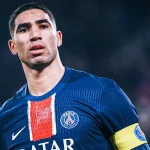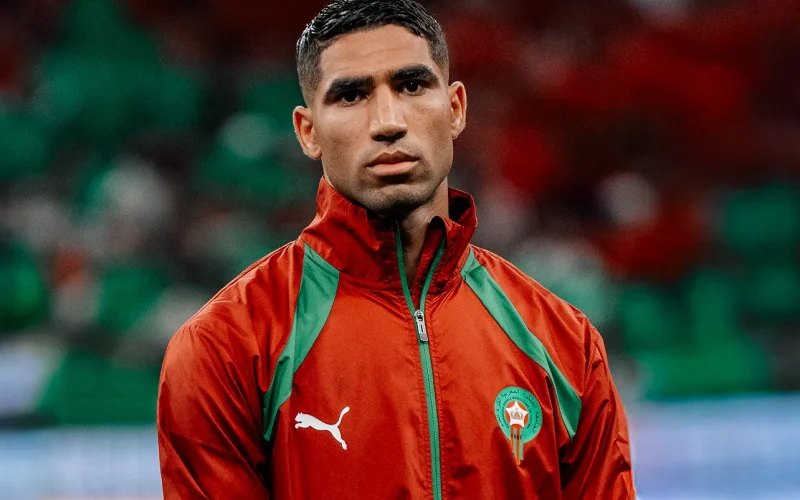
HE has nutmegged the best wingers in Europe. He has charged down the flanks of the Stade de France, the Bernabéu, and the Etihad, leaving defenders grasping at shadows. He has marshalled Morocco’s backline through World Cup semi-finals and Africa Cup of Nations, earning the continent’s highest individual football honour along the way.
But Achraf Hakimi – the 27-year-old who earns his extraordinary living by stopping opponents in their tracks – now finds himself unable to stop the most consequential charge of his life.
A French investigating judge has ordered the Paris Saint-Germain right-back and Morocco captain to stand trial on rape charges stemming from an alleged incident at his suburban Paris home in February 2023. If convicted, Hakimi faces up to 15 years in a French prison. His glittering career – the Champions League titles, the continental captaincy, the €60 million market valuation – could be reduced to rubble.
The man who defends for a living must now defend himself.
The case traces back to January 2023, when a then-24-year-old woman connected with Hakimi through Instagram – the social media pipeline through which modern celebrity and ordinary life so often collide with unpredictable consequences.
On the night of February 24, 2023, while Hakimi’s family was reportedly away, he allegedly arranged a taxi to bring the woman to his residence in Boulogne-Billancourt, an affluent suburb southwest of Paris that has become a favoured address for the capital’s footballing elite.
What happened inside that home is now the subject of fierce and irreconcilable dispute.
The woman alleges that Hakimi kissed her without consent, groped her over her clothing, and then raped her despite her repeated objections. She says she pushed him away with her foot, frantically messaged a friend for help, and fled the residence in a state of acute distress when her friend arrived. Two days later, on February 26, she reported the incident to police in Val-de-Marne.
Hakimi denies every element of the allegation absolutely and categorically. He calls it false. He calls it a lie.
French justice moves with characteristic deliberateness, and this case has been no exception. Hakimi was placed under formal investigation on March 3, 2023 – subjected to questioning and judicial supervision, including a no-contact order with the accuser – but was neither detained nor suspended from football. He played on.
He collected trophies. He won Africa’s Player of the Year. He captained Morocco. He attended the FIFA Best awards ceremony while under active judicial scrutiny. PSG, consistent with French legal norms that presume innocence until conviction, kept him in the starting eleven and named him vice-captain.
Then, in August 2025, Nanterre prosecutors formally requested that Hakimi face a full criminal trial. On February 23, 2026 – nearly three years after that night in Boulogne-Billancourt — an investigating judge agreed. The trial order was signed.
No date has yet been set. But the courtroom confrontation is now inevitable.
The Competing Narratives: Evidence and Its Conspicuous Absence
The legal battle ahead will be brutal precisely because it pivots on a profound evidentiary paradox – and both sides know it.
Hakimi’s lawyer, Fanny Colin, is blunt in her assessment: the prosecution’s case rests almost entirely on the accuser’s testimony, constructed without the forensic scaffolding that typically supports such charges. According to his defence, the complainant declined medical examinations, refused DNA testing, withheld her phone for analysis, and declined to name her supporting witness. Two psychological evaluations reportedly found no post-traumatic stress symptoms and raised questions about the clarity of the allegations themselves.
Colin has announced plans to appeal the trial order and characterises the case as a prosecution built on obstruction rather than evidence. Hakimi, by contrast, cooperated fully — voluntarily providing his DNA and requesting the opportunity to present his account.
In a defiant post on X on February 24, 2026, Hakimi wrote with barely concealed fury: “Today, a rape accusation is enough to justify a trial even when I contest it, and everything shows it is false. This is as unfair for the innocent as it is for sincere victims. I await this trial calmly, which will allow the truth to come out publicly.”
His accuser’s attorney, Rachel-Flore Pardo, responded with equal resolution — welcoming the trial order after what she described as three years of gruelling proceedings, and expressing relief that her client would finally have her day in court.
Two lawyers. Two clients. Two diametrically opposed versions of one February night. One courtroom to decide which version survives.
The Stakes: A Career, a Legacy, a Life
The football establishment, characteristically conflict-averse, has largely kept its distance. PSG coach Luis Enrique, when pressed ahead of a Champions League fixture against Monaco, offered only that the matter was for the justice system to resolve – and confirmed Hakimi would take his place in the squad. The Moroccan Football Federation has issued no statement of concern. Sponsors remain publicly intact.
But the numbers tell the story of what hangs in the balance with cold, unflinching clarity.
A conviction could activate moral clauses buried in Hakimi’s reported €8-10 million annual PSG contract, allowing the club to terminate it without compensation – echoing the fate of Benjamin Mendy, the Manchester City defender whose career was consumed by similar charges. FIFA regulations would bar a convicted and imprisoned player from official competition for the duration of any sentence. Morocco’s captaincy would evaporate. A market value currently assessed at €60 million would collapse to nothing. Adidas and other commercial partners carry conduct clauses specifically designed for such contingencies.
At 27, Hakimi is at the absolute apex of his powers – the complete modern full-back, equally devastating in attack as he is disciplined in defence. A prison sentence of seven to fifteen years would not merely pause his career. It would end it entirely, with no realistic prospect of return.
A Mirror Held Up to Modern Football
The Hakimi case arrives at a moment when European football is being forced, however reluctantly, to reckon with the behaviour of its most celebrated and protected figures. The #MeToo era has not bypassed sport; it has simply taken longer to penetrate the insulated world of billion-euro clubs, adoring federations, and agents skilled in the management of inconvenient truths.
What makes this case particularly combustible is precisely its lack of resolution. There is no confession. There is no clear forensic verdict. There is a woman who says she was violated in a wealthy man’s home, and a wealthy man who says the encounter never happened as described. Between those two positions lies a chasm that only a trial — messy, public, and unsparing — can attempt to bridge.
For three years, Achraf Hakimi has performed the extraordinary weekly act of defending against the finest forwards in world football while simultaneously navigating a criminal investigation that most athletes would find psychologically paralysing. That duality — the stadium and the investigation room, the Champions League and the court date — is now unsustainable.
The trial will come. The truth, or at least the law’s best approximation of it, will be delivered.
The man who dribbles past opponents for a living can no longer dribble past this.
Achraf Hakimi denies all allegations. He has not been convicted of any offence. The case is sub judice, and no trial date has been set.