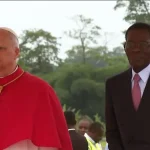
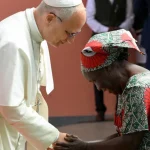
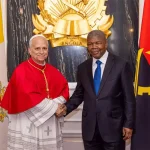
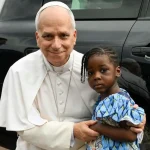
HE landed in Algiers to gun salutes and a state ceremony on Monday, but Pope Leo XIV’s arrival in Africa carries a weight that no 21-gun volley can fully capture. In touching down in Algeria — the first Catholic pontiff ever to set foot in that nation — the 70-year-old American-born pope opened the most politically and spiritually freighted chapter of his young papacy. Over the next ten days, across 18 flights covering nearly 18,000 kilometres, through four countries, 11 cities and 25 planned speeches, Leo will attempt something that every modern pope has tried, and none has fully achieved: making Africa the centre of the Catholic story, rather than its rapidly growing, habitually overlooked periphery.
The stakes could hardly be higher. More than 288 million Catholics now live on the African continent — over 20 percent of the global total, according to the latest Vatican yearbook. Africa contributed more than half of the 15.8 million new Catholics baptised worldwide in 2023 alone. Angola and Cameroon, two of Leo’s three sub-Saharan stops, consistently rank among the continent’s largest producers of seminarians. The church Francis built in Rome on European foundations is dying in Europe. The church that Leo XIV inherits is being reborn, with extraordinary velocity, in Africa.
Africa contributed more than half of the world’s 15.8 million new Catholics baptised in 2023. The centre of Catholic gravity has moved. It just hasn’t moved the Vatican — yet.
Cardinal Michael Czerny, a senior Vatican official and one of Leo’s closest advisers, stated the mission with unusual bluntness before the pope’s departure. The visit, Czerny told Reuters, was designed “to help turn the world’s attention to Africa.” That formulation is notable for what it concedes: the world’s attention is not on Africa. And a church whose fastest-growing constituency lives on this continent has work to do.
AN AUGUSTINIAN HOMECOMING
The choice to begin in Algeria is not accidental. On the night of his election in May 2025, Leo XIV stood on the balcony of St Peter’s Basilica and declared himself ‘a son of Saint Augustine.’ That proclamation has shaped every major speech and apostolic letter of his first year — and it draws a direct spiritual line to the sun-scorched soil of the Algerian northeast, to the ancient city of Hippo, where Augustine of Hippo served as bishop from 395 CE until his death in 430. Hippo is now Annaba. On Tuesday, Leo will pray at the ruins of that ancient town — the first Augustinian-order pope in the church’s two-thousand-year history, walking the ground where the theologian who most profoundly shaped Western Christian thought was buried.
The symbolism is laden. Algeria is an overwhelmingly Muslim country of some 48 million people, with fewer than 9,000 Catholics — the majority of them foreign students, migrant workers, diplomatic staff and religious. There has never been a papal visit here. The institutional Christian presence that once made North Africa the intellectual heartland of early Christianity was effectively extinguished over the centuries. Leo arrives not to reclaim it, but to honour it — and, crucially, to demonstrate that Christianity and Islam are not civilisational adversaries.
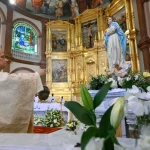
At the Great Mosque of Algiers — the third largest in the world, opened only in 2019 — Leo will make only his second visit to a mosque since his election. At the Basilica of Our Lady of Africa, built in 1872, an inscription above the main altar reads: ‘Our Lady of Africa, pray for us and for the Muslims.’ That inscription has defined the peculiar character of the Algerian church for more than a century. Leo has made it the spirit of his entire African journey.
Algeria’s tiny Catholic community of fewer than 9,000 is the most dramatic symbol of what Leo’s visit is really about: not numbers, but the quality of encounter between faiths in a divided world.
‘WHAT WILL IT CHANGE AFTERWARDS?’
Yet the politics of this first stop are not simple. The United States government has placed Algeria on its special watch list for ‘having engaged in or tolerated severe violations of religious freedom.’ The Algerian constitution recognises faiths other than Islam, but proselytising by non-Muslims to Muslims remains a criminal offence. Forty-seven churches of the Protestant Church of Algeria have been closed by authorities, according to the 2026 Open Doors World Watch List. Algerian authorities rejected a Vatican request for Leo to visit the Tibhirine monastery in Médéa — the site where seven French Trappist monks were kidnapped and killed by Islamist insurgents in 1996. Two Augustinian nuns were also among the 19 Catholic martyrs of Algeria’s brutal 1990s civil war, which killed between 100,000 and 200,000 people.
A student in Annaba, Selma Dénane, captured the ambivalence that trails Leo’s visit like a shadow. ‘I imagine it’s a good thing that a pope is visiting Algeria,’ she told the Associated Press. ‘But what will it change afterwards? Will Christians be able to say, “I am a Christian” without fear or stigmatisation?’
That question will hang over every speech Leo delivers in Algeria. He is expected to address Christian-Muslim dialogue, migration — Algeria is a critical transit point for refugees and migrants from sub-Saharan Africa and the Middle East — and the environment. The Vatican has confirmed he will visit a monument commemorating Algeria’s 1954-1962 war of independence, a gesture that acknowledges, with delicacy, the profound ambivalence between a formerly colonised Muslim nation and a Catholic Church historically entangled with European imperialism.
A CONTINENT’S GRIEVANCES, A POPE’S MANDATE
From Algeria, Leo moves south and east: to Cameroon from April 15 to 18, then to Angola from April 18 to 21, and finally to Equatorial Guinea from April 21 to 23. The Vatican has given each country a distinct theme, but they all resolve to the same preoccupation: peace in a continent that has suffered disproportionately from war, exploitation, and the predatory governance of its own elites.
In Cameroon, Leo will confront the unresolved wound of the Anglophone crisis — an armed separatist conflict in the country’s northwest and southwest regions that has displaced hundreds of thousands. Cameroon’s President Paul Biya, who has held power for more than four decades, has been repeatedly accused of human rights abuses, a charge his government denies. Vatican spokesperson Matteo Bruni confirmed that the dangers of political corruption will be among Leo’s explicit themes. The biggest single event of the entire Africa journey is expected to occur in Douala on Friday, when some 600,000 faithful are anticipated for a papal Mass — a gathering of a scale and intensity that Europe has not witnessed in a generation.
In Angola, the theme of reconciliation confronts a country still living with the aftermath of a 27-year civil war, fuelled by Cold War proxy competition and the curse of oil wealth. Angola has one of the continent’s highest levels of income inequality. Its Catholic Church, in the absence of adequate state provision, has become the primary non-governmental institution filling gaps in education and healthcare — and is now absorbing waves of refugees fleeing violence in the neighbouring Democratic Republic of Congo. An estimated two million pilgrims are expected at the Shrine of Our Lady of the Conception of Muxima, where Leo will lead a public rosary — potentially the largest single gathering of the entire trip.
In Equatorial Guinea, where nearly 90 percent of the population identifies as Catholic, Leo will face a government accused of egregious human rights violations under President Teodoro Obiang Nguema Mbasogo, the world’s longest-serving head of state. Leo’s planned visits to a psychiatric hospital and a prison in Equatorial Guinea carry unmistakable intent: this pope does not come merely to bless the powerful.
Cameroon, Angola, Equatorial Guinea: three nations where Catholic majorities live under governments accused of decades of abuse. Leo is not coming to look away.
THE WAR IN THE ROOM
Leo’s Africa visit does not take place in a geopolitical vacuum. The pontiff has emerged, in his first year, as one of the most outspoken critics of the US-Israeli war against Iran — a conflict whose humanitarian and economic shockwaves are battering the African continent, disrupting aviation, driving up commodity prices and destabilising already fragile states. The night before his departure, US President Donald Trump issued an extraordinary public broadside against Leo, saying he should ‘stop catering to the Radical Left.’ Leo had delivered a homily blasting what he called ‘the delusion of omnipotence’ driving the war.
The exchange confirmed a rupture between the first American pope and the American government that is unprecedented in modern church-state relations. It also clarified Leo’s political posture as he arrives in Africa: he does not come as an envoy of Western interests. He comes as a pastor — and, increasingly, as a critic of the world order that has left Africa bearing the costs of conflicts it did not choose.
THE 24TH AFRICAN JOURNEY — AND THE MOST CONSEQUENTIAL
This is the 24th papal journey to Africa since the late 1960s, when Paul VI first crossed the equator. Leo’s predecessors — John Paul II, who visited the continent 14 times, and Francis, who made three trips — each sought to affirm Africa’s place in the Catholic imagination. But none has arrived at a moment when the demographic reality so starkly demands more than affirmation.
The numbers are unambiguous. Africa is the fastest-growing region in the global Catholic Church: from 281 million members in 2023 to more than 288 million in 2024. If current trajectories hold, Africa will be home to the majority of the world’s Catholics within the lifetime of many people attending the Douala Mass on Friday. The continent is no longer receiving missionaries; it is exporting priests and nuns to a declining Europe. The institutional weight of the church has not yet shifted to reflect this reality. Leo’s journey is an argument that it must.
Cardinal Czerny’s blunt formulation bears repeating: this trip exists ‘to help turn the world’s attention to Africa.’ The quiet implication is that the world — and the Vatican’s own internal power structures — have been looking elsewhere for too long. Whether Leo’s 25 speeches, his 18 flights, his visits to the ruins of Augustine’s city and the prisons of Equatorial Guinea and the orphanages of Cameroon can move that needle is not yet clear.
What is clear is that he came. And in the complex calculus of papal symbolism, presence matters. The journey has begun.