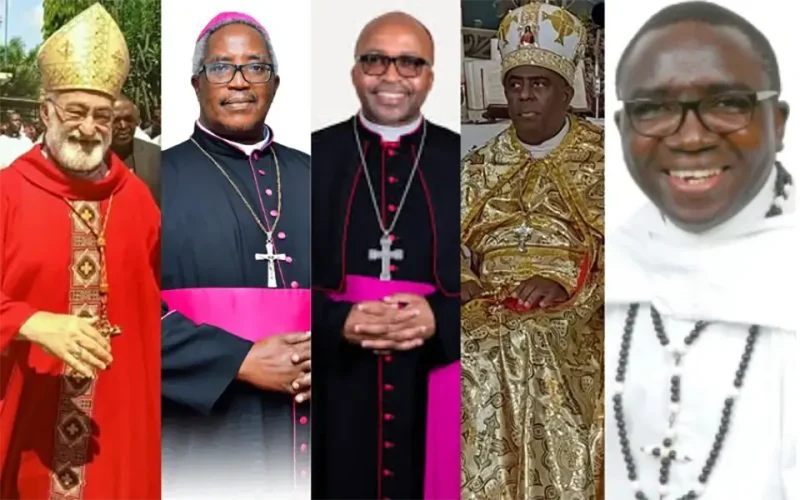
IN a move that reverberates across the African continent and beyond, Pope Leo XIV has made a historic decision that underscores Africa’s growing influence within the global Catholic Church. On June 24, 2025, the Holy See announced the appointment of five distinguished African church leaders to the Vatican Dicastery for Institutes of Consecrated Life and Societies of Apostolic Life – a powerful signal that the Church’s future is increasingly intertwined with the vibrant faith communities of Africa.
For a continent home to over 230 million Catholics – nearly one-fifth of the world’s Catholic population – these appointments represent more than administrative changes. They symbolise a fundamental shift in how the universal Church recognises and embraces the theological insights, pastoral wisdom, and spiritual dynamism that African Catholicism brings to the global table.
The five appointees span the breadth of Africa’s ecclesiastical landscape: from Morocco’s multicultural north to South Africa’s complex south, from Tanzania’s Swahili-speaking east to Zambia’s copper belt, and Ethiopia’s ancient Christian heritage in the Horn of Africa. Each brings decades of experience navigating the unique challenges and opportunities that define African Catholicism in the 21st century.
Voices of Experience and Vision
Cardinal Cristóbal López Romero of Rabat, Morocco, stands as a bridge-builder between Christianity and Islam in North Africa. At 72, this Spanish-born Salesian has spent years fostering dialogue in a region where Catholics are a small but significant minority. His appointment brings crucial interfaith expertise to the Vatican’s decision-making processes at a time when Christian-Muslim relations remain vital to global peace.
Archbishop Jude Thaddaeus Ruwa’ichi of Dar-es-Salaam represents the face of East African Catholicism. Born in Tanzania’s Diocese of Moshi in 1953, this Franciscan Capuchin has witnessed his country’s Church grow from strength to strength. His journey from rural diocese to leading one of Africa’s most important archdioceses embodies the upward trajectory of African Church leadership.
From Southern Africa comes Bishop Thulani Victor Mbuyisa of Kokstad, South Africa—at 52, the youngest of the appointees. A member of the Mariannhill Missionaries, Bishop Mbuyisa brings the perspective of post-apartheid South Africa and currently chairs the Justice and Peace Commission of the Southern African Catholic Bishops’ Conference. His appointment signals that social justice and human dignity remain central to the Church’s mission in Africa.
Bishop Tesfaye Tadesse Gebresilasie, Ethiopia’s Auxiliary Bishop of Addis Ababa, adds another crucial dimension. As a Comboni Missionary with deep expertise in Islamic studies, he represents the Church’s commitment to dialogue and understanding in the Horn of Africa, where Christianity has ancient roots but faces modern challenges.
Father Stanley Lubungo, the Zambian-born Superior General of the Missionaries of Africa (White Fathers), completes this remarkable quintet. His leadership of an organisation founded specifically for African evangelisation, combined with his missionary experience across the continent, brings institutional memory and forward-looking vision to the Vatican’s deliberations.
Beyond Symbolism: Strategic Significance
These appointments transcend symbolic representation. They position African church leaders at the heart of Vatican decision-making regarding religious life worldwide—a role that reflects Africa’s status as the Church’s most dynamic growth region.
Africa’s Catholic population has grown exponentially over the past century, transforming from a mission territory to a powerhouse of faith, vocations, and theological scholarship. The continent produces more priests and religious sisters than any other region, and African seminaries are filled to capacity while their European counterparts struggle with declining numbers.
This demographic reality is now matched by institutional recognition. By placing five African leaders in positions of influence within the Vatican’s bureaucracy, Pope Leo XIV acknowledges that the future of Catholic religious life – monasteries, convents, missionary societies, and lay religious movements – will be increasingly shaped by African insights and experiences.
A Church Transformed
The historical significance of these appointments cannot be overstated. For centuries, the Catholic Church’s global direction was determined primarily by European voices. Today’s announcement represents a seismic shift toward a truly global Church where African wisdom helps guide universal decisions.
These leaders bring unique perspectives forged by their continental experiences: navigating religious pluralism, addressing poverty and social justice, fostering interfaith dialogue, and building vibrant faith communities despite significant challenges. Their appointment to the Vatican Dicastery means these perspectives will now influence how the global Church approaches religious life in all six continents.
The Road Ahead
As these five leaders take up their new responsibilities, they carry with them the hopes and prayers of Africa’s Catholics. Their success will likely open doors for even greater African participation in Vatican leadership, potentially influencing everything from papal policy to global Church priorities.
For Africa’s Catholic faithful, these appointments offer validation of their Church’s maturity and significance. No longer can African Catholicism be viewed as peripheral to the global Church’s mission. Instead, it stands recognised as central to the Church’s present vitality and future direction.
The announcement of June 24, 2025, may well be remembered as a turning point—the day when Africa’s voice in the Vatican grew unmistakably stronger, and the global Catholic Church took another decisive step toward truly reflecting the universal nature of its mission.
In boardrooms and parishes, seminaries and convents across Africa, the news will be received with pride and hope. In these five appointments, the continent’s Catholics see not just individual achievements, but the recognition of Africa’s rightful place in shaping the Church’s global future.