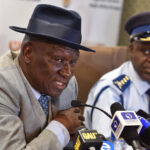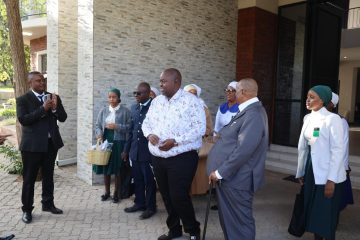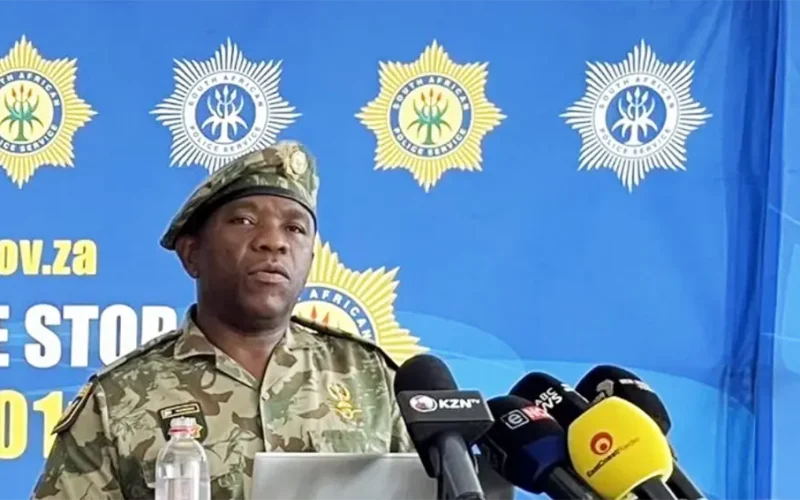
IN what may be the most damning exposé of state capture since the Zondo Commission, KwaZulu-Natal Police Commissioner Lieutenant General Nhlanhla Mkhwanazi has dropped a bombshell that has sent shockwaves through South Africa’s political establishment. In a tense media briefing that will be remembered as a watershed moment in the country’s fight against corruption, Mkhwanazi revealed the existence of a powerful drug cartel in Gauteng that allegedly controls top police officials, prosecutors, judges, and politicians currently sitting in Parliament.
“Business as Usual” vs. Criminal Complaints: The Battle Lines Are Drawn
The explosive revelations have triggered a fierce war of words within the highest levels of law enforcement. Police Minister Senzo Mchunu has categorically denied the allegations against him, dismissing Mkhwanazi’s claims and reportedly daring the provincial commissioner to follow through on his threats to act. Sources close to the minister describe him as “unfazed” by the criminal complaint and confident that the allegations will not stand up to scrutiny.
Adding to the institutional chaos, National Police Commissioner General Fanie Masemola has called for “business as usual” within the police force, seemingly attempting to contain the fallout from Mkhwanazi’s bombshell revelations. This response has been interpreted by some as an attempt to downplay the severity of the allegations, while others see it as necessary damage control to prevent the complete collapse of public confidence in law enforcement.
Presidential Promise: Ramaphosa to Act After BRICS Summit
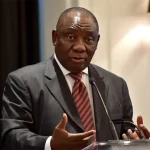
President Cyril Ramaphosa has broken his silence on the crisis, issuing a carefully worded statement that acknowledges the gravity of the situation while stopping short of taking immediate action. In his statement, the President declared: “This is a matter of grave national security concern that is receiving the highest priority attention. It is vital that the integrity of the country’s security services is safeguarded and that the rule of law is affirmed.”
However, Ramaphosa has deferred decisive action, stating that he will outline specific measures only upon his return from the BRICS Leaders’ Summit currently underway in Rio de Janeiro, Brazil. This delay has drawn criticism from opposition parties and civil society groups, who argue that the situation demands immediate intervention.
The President’s call for “discipline and restraint” from all parties, warning that “trading of accusations and counter-accusations threatens to undermine public confidence and sow confusion,” has been interpreted by some as an attempt to silence Mkhwanazi’s explosive revelations. Critics argue that this response prioritizes political stability over justice and accountability.
The revelations, described by political analysts as among the most significant in post-apartheid South Africa, have triggered a high-stakes confrontation between Mkhwanazi and the very officials he accuses of criminal conduct. With the Police Minister denying the allegations and daring the commissioner to act, and the National Police Commissioner calling for “business as usual,” the stage is set for an unprecedented battle within South Africa’s law enforcement hierarchy.
The Smoking Gun: 121 Suppressed Case Dockets
At the heart of Mkhwanazi’s explosive allegations lies a trail of 121 case dockets that were mysteriously removed from a specialized police unit and shelved at police headquarters in Pretoria. These dockets, compiled by the now-disbanded Political Killings Task Team, contained detailed evidence of a national criminal syndicate with tentacles reaching into the highest echelons of government.
The commissioner revealed that among these suppressed files were actual arrest warrants for key perpetrators—warrants that were never executed despite containing compelling evidence against high-ranking officials. The systematic burial of these cases points to what investigators describe as one of the most sophisticated obstruction of justice operations in South Africa’s democratic history.
“These dockets didn’t just disappear,” Mkhwanazi declared, his voice heavy with the weight of his revelations. “They were deliberately removed and shelved under orders that came from the very top of our police hierarchy.”
Minister Under Fire: Criminal Complaint Filed
In an unprecedented move that has rocked the corridors of power, Mkhwanazi has filed a criminal complaint against Police Minister Senzo Mchunu, accusing him of deliberately interfering in police operations by disbanding the Political Killings Task Team just as it was closing in on the criminal network.
The commissioner’s accusations against Mchunu are particularly damning. He alleges that the minister, working in conjunction with Deputy National Commissioner Shadrack Sibiya—whom Mkhwanazi branded outright as “a criminal”—orchestrated the systematic dismantling of the investigation to protect powerful interests within the syndicate.
Perhaps most explosive is Mkhwanazi’s claim that Mchunu misled Parliament about his relationship with Brown Mokgotsi, an associate who allegedly had access to classified police documents and influenced crucial internal decisions, including the disbandment of the task team itself.
“I Am Combat Ready” – A Commissioner’s War Declaration
In a moment that will be etched in South African law enforcement history, Mkhwanazi declared himself “combat ready” and stated his willingness to “die for the badge.” This wasn’t mere rhetoric—it was a declaration of war against a criminal network so powerful and entrenched that it has successfully captured key institutions of state.
The commissioner’s courage in speaking out cannot be overstated. In a country where whistleblowers often face dire consequences, Mkhwanazi’s willingness to expose the conspiracy knowing full well the risks involved demonstrates the gravity of the situation and the extent of the criminal network’s reach.
The Web of Corruption: How Deep Does It Go?
The evidence compiled by the disbanded task team paints a picture of corruption that defies comprehension. The drug syndicate’s influence extends far beyond street-level operations, reaching into:
The Judiciary: Judges allegedly compromised and influenced by the cartel, potentially affecting the outcome of crucial cases and undermining the independence of the courts.
The Police Force: Top police officials allegedly on the cartel’s payroll, manipulating investigations, protecting criminal operations, and eliminating rivals through selective enforcement.
The Prosecution Service: Senior prosecutors allegedly compromised, ensuring that cases against the syndicate never see the light of day or result in meaningful convictions.
Parliament: Current MPs allegedly implicated in the network, using their positions to influence legislation and protect the syndicate’s interests.
The multidisciplinary approach of the Political Killings Task Team—involving SAPS, the National Prosecuting Authority, State Security, and Correctional Services—enabled investigators to uncover these high-level connections. Their work revealed a criminal enterprise so sophisticated and well-connected that it operates with virtual impunity.
International Connections: The Global Supercartel
The revelations become even more alarming when viewed in the context of South Africa’s role as a hub for international drug trafficking. Investigations have uncovered connections between local officials and what experts describe as a global “supercartel” operating through South Africa.
Recent high-profile drug busts, including a R2-billion methamphetamine laboratory seizure in Limpopo with international suspects, highlight the scale and sophistication of these operations. The fact that such massive operations can function suggests protection from the highest levels of government and law enforcement.
Ramaphosa’s Calculated Response: Damage Control or Decisive Leadership?
President Cyril Ramaphosa now faces what may be the defining moment of his presidency, but his initial response has raised questions about whether he will provide the decisive leadership the crisis demands. His statement acknowledging the matter as one of “grave national security concern” while simultaneously calling for restraint has been criticized as an attempt to manage the political fallout rather than pursue justice.
The President’s decision to delay action until after the BRICS Summit has drawn sharp criticism from opposition parties. Democratic Alliance leader John Steenhuisen called the delay “unconscionable,” stating that “while the President plays international diplomat, the very foundations of our democracy are under attack at home.” The Economic Freedom Fighters have gone further, demanding Ramaphosa’s immediate return to South Africa to address what they describe as “the complete capture of our law enforcement agencies.”
Political analyst Dr. Susan Booysen notes that Ramaphosa’s response reflects the impossible position he finds himself in: “He cannot ignore allegations of this magnitude, but taking immediate action against his own Police Minister would destabilize his coalition government. The delay allows him to craft a response that may satisfy both justice and political expediency.”
However, critics argue that there is no middle ground in this crisis. Civil society organization Corruption Watch has stated that “the President’s call for restraint in the face of such explosive allegations sends a dangerous message that political considerations trump the rule of law.”
The Stakes: Democracy in the Balance
The implications of these revelations extend far beyond individual careers or political parties. At stake is the very foundation of South Africa’s democratic institutions and the rule of law. If the allegations are true, South Africa faces a crisis of state capture that dwarfs even the Zuma years.
The systematic suppression of evidence, the protection of criminal networks, and the compromise of key institutions represent a direct threat to constitutional democracy. The question is no longer whether corruption exists within South Africa’s institutions—it’s whether those institutions can survive the level of criminal infiltration that has been exposed.
Opposition Demands Action
Opposition parties and civil society organizations have already begun mobilizing, demanding swift action to restore integrity and accountability. The Democratic Alliance, Economic Freedom Fighters, and other opposition parties are calling for parliamentary investigations, while civil society groups are demanding that Ramaphosa choose between his political allies and the rule of law.
The pressure is mounting from all sides, with some calling for a complete overhaul of the police leadership and others demanding a new commission of inquiry into the captured institutions.
The Road Ahead: A Nation Awaits Presidential Action
As South Africa awaits President Ramaphosa’s promised response upon his return from Brazil, the nation stands at a crossroads. The revelations by Commissioner Mkhwanazi have shattered any remaining illusions about the extent of criminal infiltration in South Africa’s institutions, while the conflicting responses from different levels of law enforcement have created a crisis of confidence in the police force itself.
The Minister’s defiant denials, the National Commissioner’s call for “business as usual,” and the President’s measured response have created a dangerous vacuum of leadership at the very moment when decisive action is most needed. This institutional paralysis plays directly into the hands of the criminal networks that Mkhwanazi has exposed.
Opposition parties have made it clear that they will not accept delays or half-measures. The Democratic Alliance has announced plans to call for a parliamentary debate on the matter, while the Economic Freedom Fighters have threatened to bring a motion of no confidence against both the Police Minister and the President if decisive action is not taken.
The choice facing Ramaphosa remains stark and unavoidable: he can either support the brave officers fighting to expose the truth, or he can protect the political interests that have enabled this criminal network to flourish. His promise to act after the BRICS Summit has bought him time, but it has also raised the stakes exponentially.
Commissioner Mkhwanazi has drawn his line in the sand. He has chosen to stand with the truth, regardless of the personal cost. The question that now haunts South Africa is whether its President will show the same courage when he returns from Brazil, or whether political calculations will once again trump justice.
The battle for South Africa’s soul has begun. The outcome will determine whether the country emerges stronger from this crisis or whether it descends further into the abyss of state capture and criminal control.
Time is running out for President Ramaphosa to prove that in South Africa, no one – not even cabinet ministers – is above the law. The nation watches and waits, but patience is wearing thin.