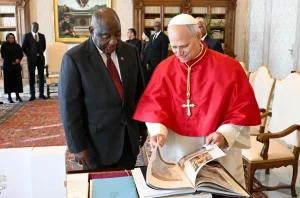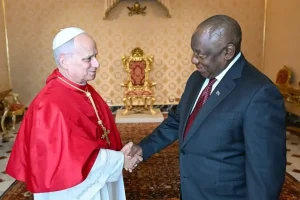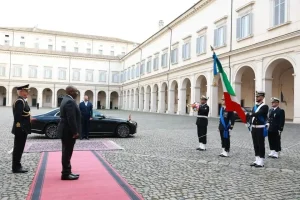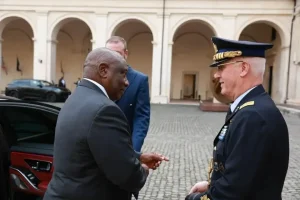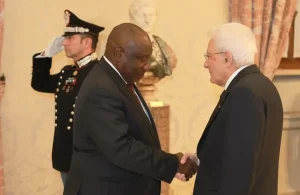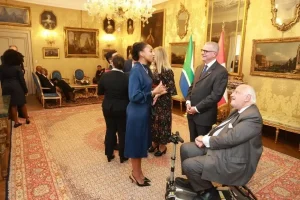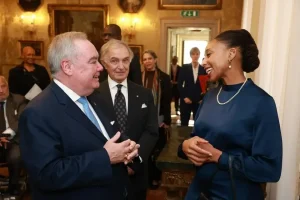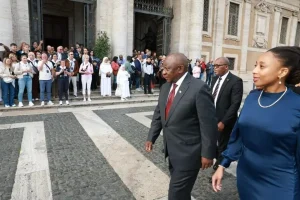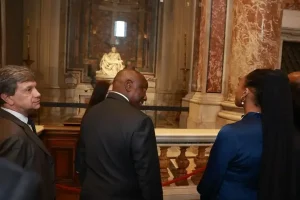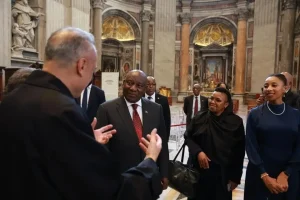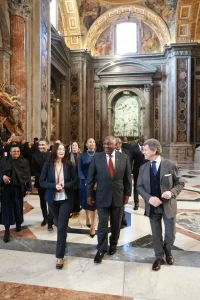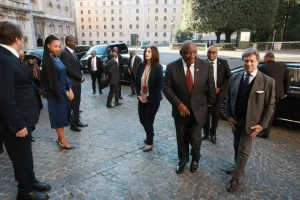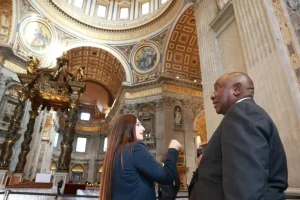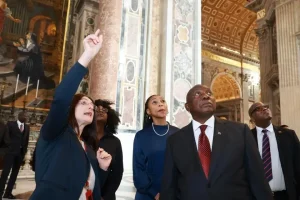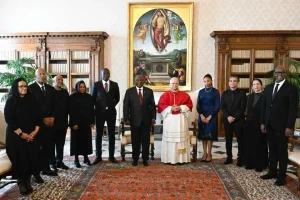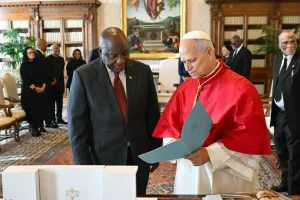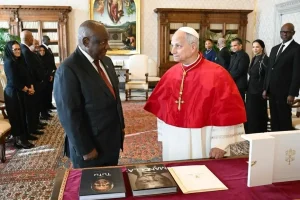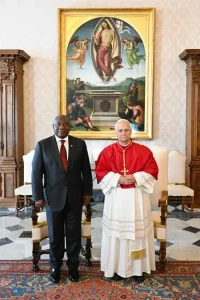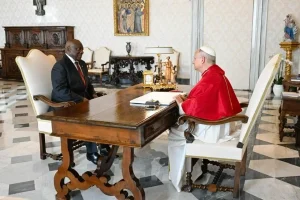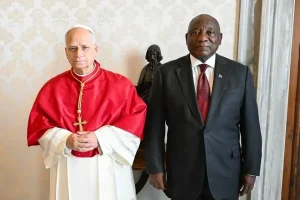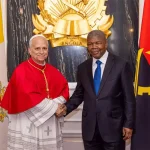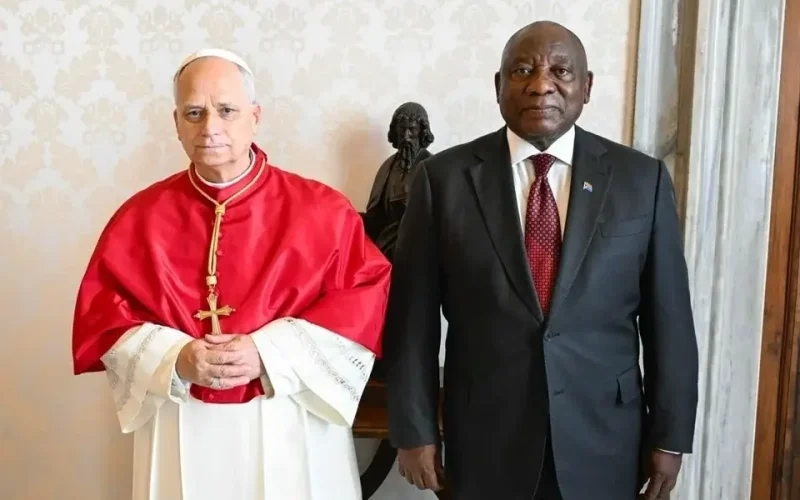
IN the gilded corridors of the Apostolic Palace, where centuries of papal diplomacy have shaped the conscience of nations, a uniquely African conversation unfolded Saturday morning. President Cyril Ramaphosa of South Africa, carrying the weight of a continent’s aspirations and the historic mantle of the G20 presidency, sat across from Pope Leo XIV in what Vatican observers are calling one of the most consequential papal audiences of the young pontificate.
The meeting was no ordinary diplomatic courtesy call. It was a collision of moral visions: the Rainbow Nation’s philosophy of Ubuntu – “I am because we are” – meeting the successor of St. Peter during a Jubilee Year of Hope, at a moment when the world seems to be fracturing along a thousand fault lines.
The timing could hardly be more charged. South Africa stands on the cusp of hosting the G20 Leaders’ Summit later this month, the first time an African nation has held this responsibility. For a continent long relegated to the margins of global decision-making, this is not merely a diplomatic victory – it is a thunderous announcement that Africa demands a seat at the table where humanity’s future is negotiated.
Ramaphosa arrived at the Vatican not as a supplicant but as a messenger, bearing what he called “a new global spirit” forged in the crucible of South Africa’s own painful journey from apartheid to democracy. His message to Pope Leo XIV was clear: the crises of our age – inequality, climate catastrophe, endless wars – cannot be solved by nations cloistering themselves behind walls of self-interest. They demand what he termed “a common front of the human spirit.”
The Substance: Beyond Pleasantries
While the Holy See’s official statement employed the measured language of Vatican diplomacy – noting “cordial talks” and “mutual appreciation” for the Catholic Church’s contributions to South African society – Ramaphosa’s prepared remarks revealed a far more ambitious agenda. This was not a president seeking a papal blessing; it was a statesman recruiting a spiritual leader for a shared mission.
The South African leader laid bare the contradictions of our moment with prophetic clarity: “To many, it seems easier to fund wars than to invest in peace.” He invoked the suffering in Sudan, the Democratic Republic of Congo, Ukraine, and Palestine, demanding that “our conscience must be consistent” in striving for peace wherever war holds human lives captive.
But perhaps most boldly, Ramaphosa challenged the global financial architecture itself. Citing the Jubilee Commission Report and the Church’s calls for reform of the international financial system, he noted that many African countries spend more servicing debt than on education or healthcare, a modern form of bondage that chains “successive generations to poverty.”
The Players: Power in different robes
Pope Leo XIV, elected as successor to the widely mourned Francis, inherits a Church grappling with its relevance in an increasingly secular world. Yet his moral authority remains formidable, with nearly 1.4 billion Catholics worldwide, and countless others who look to the Vatican as a voice for the voiceless. For a pope seeking to establish his legacy, Ramaphosa offered something invaluable: partnership with a nation that embodies both the promise and pain of the Global South.
Ramaphosa, for his part, came to Rome strengthened by South Africa’s nearly 4 million Catholics, a “cross section” of the nation’s multicultural tapestry, as he described them. But he also came bearing scars: the economic inequality that persists three decades after apartheid’s fall, the electricity crisis that has crippled industry, the corruption scandals that have tarnished his own presidency. His G20 chairmanship is an opportunity for redemption, a chance to prove that Africa can lead, not merely follow.
The Philosophy: Ubuntu Goes Global
The heart of Ramaphosa’s pitch to Pope Leo XIV was philosophical, even spiritual. He framed South Africa’s G20 presidency around Ubuntu, the Southern African concept that recognises “our shared humanity.” This wasn’t a mere rhetorical flourish. Ubuntu, as Ramaphosa explained it, means understanding that “the human impulse is not towards isolation, but towards community.” It means recognising that “the strong discover their true strength not in dominion, but in lifting up the weak.”
This is a direct challenge to the transactional, zero-sum thinking that increasingly dominates international relations. Where populists preach nationalism and great powers pursue hegemony, Ramaphosa offered an alternative vision: “dignified, prosperous coexistence,” borrowing the Pope’s own words from a previous audience.
The question is whether this philosophy can survive contact with the brutal realities of geopolitics. Can Ubuntu bridge the chasm between the United States and China? Can it bring Russia to the negotiating table over Ukraine? Can it compel wealthy nations to cancel crushing African debt?
The Church’s Role: Moral Authority Meets Material Reality
Ramaphosa’s recognition of the Catholic Church’s contributions to South African society – in education, healthcare, and fostering reconciliation – was not mere flattery. Faith-based communities, he noted, “have been at the forefront of our struggle for democracy, human rights and social justice.” From Archbishop Desmond Tutu’s Truth and Reconciliation Commission to countless Catholic schools educating the children of the poor, the Church has been woven into South Africa’s moral fabric.
But the President was asking for something more than continued good works. He was inviting Pope Leo XIV to throw the full weight of his moral authority behind the G20’s agenda of “Solidarity, Equality, Sustainability.” And in a moment heavy with symbolism, he extended a formal invitation, joined by the Southern African Catholic Bishops’ Conference, for the Pope to visit South Africa.
A papal visit would be profound. Pope Francis never made it to South Africa, and Pope John Paul II’s 1995 visit came at the dawn of democracy. For Pope Leo XIV to visit now, as South Africa hosts the G20, would signal the Vatican’s commitment not just to spiritual matters but to the restructuring of global power.
What went unsaid in Saturday’s meeting may be as significant as what was discussed. South Africa’s relations with Russia have drawn Western criticism, particularly its refusal to condemn Moscow’s invasion of Ukraine with the vehemence demanded by European and American allies. Ramaphosa has positioned South Africa as a neutral mediator, but critics call it moral equivocation.
Similarly, South Africa’s strong support for Palestinian statehood – it has brought a genocide case against Israel at the International Court of Justice – puts it at odds with many Western nations. Yet Ramaphosa’s invocation of Palestine alongside Ukraine in his Vatican remarks was deliberate, insisting on what he called “consistent conscience” in confronting human suffering.
The Vatican, too, walks diplomatic tightropes. Pope Leo XIV must balance relationships with powerful Western nations while maintaining the Church’s prophetic voice for peace and justice. Whether the Holy See can fully embrace South Africa’s vision without alienating other constituencies remains to be seen.
For Africa, this G20 presidency represents a singular opportunity. The continent of 1.4 billion people – projected to reach 2.5 billion by 2050 – has long been treated as a charity case or a resource extraction zone rather than a protagonist in global affairs. Ramaphosa’s vision of centring “the social, economic and environmental development of Africa and the Global South” in G20 discussions is nothing short of revolutionary.
But Africa’s leverage is limited. The continent accounts for roughly 3% of global GDP despite having 18% of the world’s population. Climate change – driven overwhelmingly by emissions from wealthy nations – threatens to devastate African agriculture and infrastructure. The promised climate finance from developed countries has largely failed to materialise. Debt burdens are crushing. And Africa’s voice in institutions like the IMF and World Bank remains marginal.
Ramaphosa needs allies with global reach and moral weight. Pope Leo XIV, leading a Church with deep roots across Africa, could be that ally. But papal support is not enough. The President will need China, the United States, Europe, and emerging powers like India and Brazil to embrace genuine reform of the international order.
The Legacy Question: Will This Moment Matter?
Presidential visits to the Vatican are common. Papal platitudes about peace and justice are expected. What makes Saturday’s meeting potentially historic is whether it catalyses action or remains merely a beautiful speech in a beautiful city.
Ramaphosa returns to South Africa bearing, as he put it, “blessings and spirit of hope” from walking through the Holy Door of St. Peter’s Basilica during this Jubilee Year. But hope is not policy. Inspiration is not reform. The test will come in the G20 summit’s outcomes: Will wealthy nations agree to meaningful debt relief? Will climate finance finally flow? Will the structures of global governance be democratised to give Africa and the Global South a genuine voice?
And for Pope Leo XIV, the question is equally pressing: Will he accept Ramaphosa’s invitation to visit South Africa? Will he use his moral authority to champion the specific reforms – in international finance, in climate justice, in peace negotiations – that the South African president outlined? Or will Saturday’s “cordial talks” dissolve into the fog of diplomatic memory?
There is something poetically fitting about this encounter. The Catholic Church, an institution that has survived empires and outlasted ideologies, meets with a nation born from the ashes of racial oppression and sustained by an indigenous philosophy of shared humanity. Both claim to speak for universal values; both grapple with how to translate ancient wisdom into modern action.
As Ramaphosa noted with striking eloquence, “Our freedom, our security and our prosperity are bound together. To ignore the plight of any is to ultimately endanger the future of all.” This could be Ubuntu speaking. It could also be the Gospel. Perhaps that common ground is where transformation becomes possible.
The world will watch South Africa’s G20 summit with varying degrees of hope and scepticism. But Saturday morning in Vatican City, in a meeting between a president bearing Africa’s aspirations and a pope seeking to define his legacy, something crystallised: the recognition that our fractured world desperately needs what Ramaphosa called “a common front of the human spirit.”
Whether that front can hold against the centrifugal forces of nationalism, inequality, and violence remains to be seen. But in the shadow of St. Peter’s dome, on a November morning thick with history, two leaders dared to imagine it might.
- The G20 Leaders’ Summit will take place in South Africa later this month, the first time an African nation has hosted the gathering of the world’s major economies.