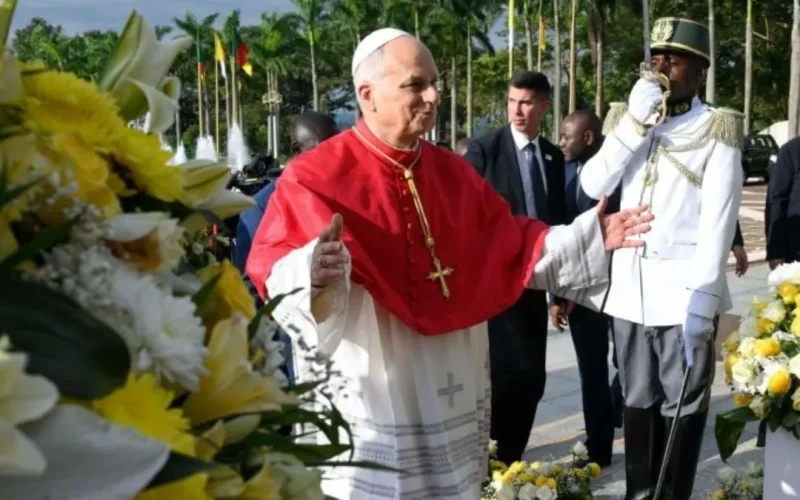
POPE Leo XIV has landed in Cameroon carrying the moral and political weight of a first leg that was, by any measure, historic. Algeria gave the world a pope who arrived not as a ceremonial figurehead but as a statesman of faith – willing to confront power, honour the martyred, pray in a mosque, and speak uncomfortable truths to authoritarian governments. What awaits him in Cameroon is an altogether different and, in many ways, far more demanding test.
The Algeria chapter of this extraordinary 11-day, four-nation apostolic journey was, from the first moments, saturated in symbolism. Arriving in Algiers on April 13, Leo became the first pope in history to set foot on Algerian soil, a country where a tiny Catholic community of around 9,000 people – mostly foreigners – exists alongside a Sunni Muslim majority of approximately 47 million. His opening message was unequivocal. Standing at the Maqam Echahid Martyrs’ Memorial, he declared that “the future belongs to men and women of peace,” and called for forgiveness as the only path to genuine liberation.
The visit carried a deeply personal dimension. Leo’s pilgrimage to Annaba – the modern Hippo – was a spiritual homecoming for the American-born Augustinian pope, who walked the archaeological ruins where the fifth-century Christian theologian Saint Augustine lived, wrote, and died. Algeria is, in a very real sense, part of Leo’s religious DNA. As Prior General of the Order of Saint Augustine, the then-Father Robert Prevost had visited the country twice, in 2001 and 2013. He told reporters on the papal plane that this African journey was supposed to have been the first of his pontificate.
But the visit was never merely sentimental. Speaking to Algeria’s diplomatic corps in Algiers, the pope warned that many societies that consider themselves advanced are falling deeper into inequality and exclusion, while “people and organizations that dominate others destroy the world.” He added that Africa knows this reality well. Addressing government officials at the presidential palace, he told an authoritarian state directly that “the true strength of a nation lies in the cooperation of everyone in pursuing the common good,” and that “authorities are called not to dominate, but to serve.”
His visit to the Great Mosque of Algiers – one of the largest mosques in the world – was a gesture aimed at reinforcing Christian-Muslim dialogue, and marked the first time Leo was clearly seen praying inside a mosque. It was a defining image: an American pope, leading the world’s largest Christian institution, standing in silence before the qibla, the wall facing Mecca.
Yet Algeria also offered Leo XIV a prelude to the geopolitical storm that would shadow the entire journey. Even before touching down, he had made headlines with candid remarks to reporters aboard the papal plane, and throughout his time in Algiers, he faced an extraordinary broadside from President Donald Trump over his public criticism of the United States-Israeli war on Iran. That confrontation – between the first American pope and an American president – forms a charged subtext to everything that follows.
Now the stage has shifted. And in Cameroon, the stakes are at once more intimate and more combustible.
This is not a country where the Church whispers at the margins. Catholicism here is woven into the national fabric. Catholics constitute roughly 30 to 35 percent of the national population, the Church operates five metropolitan provinces, maintains extensive networks of schools and hospitals, and the bishops’ conference regularly issues pastoral statements on elections, governance, and corruption. Leo XIV will not be received as an outside voice; he enters a Church that already considers itself central to the republic’s identity.
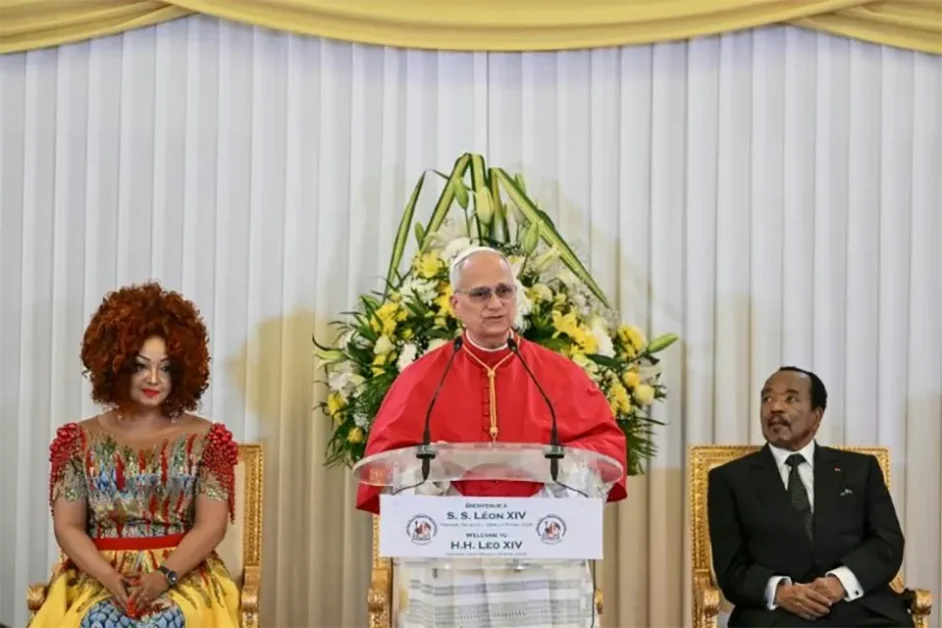
The three cities on his Cameroon itinerary – Yaoundé, Bamenda, and Douala – are not interchangeable stops on a logistical schedule. Each represents a distinct, charged dimension of the Cameroonian story. Yaoundé is the political capital and the Church-state interface. Douala is the economic engine and the venue for what Vatican officials say could draw as many as 600,000 faithful to an open-air Mass adjacent to the Japoma Stadium. And Bamenda is a wound that has not healed.
The Anglophone crisis – an armed conflict between separatist groups and Cameroonian security forces that has ravaged the North West and South West regions for nearly a decade – places Bamenda at the moral centre of this visit. The bishops of the region, operating under conditions of genuine danger, have consistently called for dialogue and the protection of civilians. Leo’s arrival in Bamenda is therefore an act of solidarity as much as a pastoral visit, and every word he speaks there will be parsed in Yaoundé, in the camps of the armed factions, and in Western chanceries.
Cameroon also confronts the pope with the contested legacy of an elderly autocracy. There was violence following the disputed 2025 reelection of 92-year-old President Paul Biya, who has governed the country since 1982. The Church has walked a careful line between its role as moral voice and its institutional interests – a tightrope that Leo will now be required to walk publicly, in real time, before a watching continent.
There is precedent for this moment. In 2009, Pope Benedict XVI visited Cameroon, using the occasion to promulgate the Instrumentum Laboris for the Second Synod for Africa – a gathering that sought to define the continent’s ecclesial future. Leo XIV’s 2026 visit arrives at a moment of no less consequence. Africa now accounts for around 20 percent of the global Catholic population and is the Church’s fastest-growing region. What the pope says and does in Cameroon – particularly in Bamenda – will reverberate far beyond Central Africa.
The chosen theme for this leg of the journey captures both its aspiration and its difficulty: unity in Christ. That unity is being tested every day in the Northwest Region, where communities live under the shadow of conflict, displacement, and grief. Whether the visit can move any of that – even symbolically – remains to be seen. What is already clear is that Leo XIV has arrived in Africa not to be seen, but to engage. Algeria proved that. Cameroon will test it.