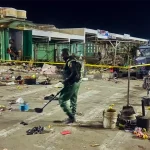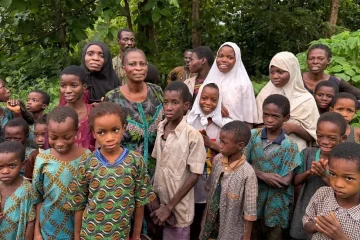
THE motorcycles arrive like harbingers of death – their engines roaring across the dusty plains of Zamfara State as armed men descend upon defenceless villages with calculated brutality. The latest assault on Sabongarin Damri has added another grotesque chapter to Nigeria’s decade-long kidnapping epidemic, leaving 11 dead and at least 70 abducted, mostly women and children whose screams now echo in the silence of yet another devastated community.
This is not an isolated incident. It is the continuation of a nightmare that began in earnest on April 14, 2014, when 276 schoolgirls were snatched from their dormitories in Chibok, Borno State, sparking global outrage and the #BringBackOurGirls movement. That singular act of terror opened the floodgates to an industry of human trafficking that has since metastasised across Nigeria’s northern regions like a malignant cancer.
The Chibok Legacy: From Global Outcry to Normalised Horror
The Chibok abduction was meant to be a watershed moment – a line in the sand that would galvanise international action and bring swift justice. Instead, it became a blueprint for terror. While the world watched and hashtags trended, criminal networks took careful notes. They observed how ransom negotiations played out, how media attention could be leveraged, and how the government’s response revealed both its desperation and its vulnerabilities.
What followed was a systematic expansion of kidnapping operations. The Dapchi schoolgirls in February 2018 – 110 students abducted, five killed, one never returned. The Kankara boys in December 2020 – 344 students were seized from their dormitories in Katsina State. The Tegina children in May 2021 – 136 Islamic school pupils taken in Niger State. The Bethel Baptist High School students in July 2021 – 121 kidnapped in Kaduna State. Each incident normalised the unthinkable, transforming mass abduction from an aberration into a recurring headline.
But these headline-grabbing cases represent merely the visible tip of an iceberg of suffering. Between these major incidents lie hundreds of smaller-scale kidnappings – farmers seized from their fields, travellers plucked from highways, entire villages emptied in pre-dawn raids. The accumulated trauma has reshaped the social fabric of northern Nigeria, where parents now sleep with one eye open and children grow up knowing that tomorrow is never guaranteed.
The Mathematics of Failed Security Spending
The Nigerian government’s response has been substantial in financial terms, yet devastatingly inadequate in practical outcomes. Defence budgets have swelled to accommodate military hardware purchases – armoured vehicles, helicopters, surveillance equipment, and weapons systems worth hundreds of millions of dollars. The military has launched countless operations with names that promised victory: Operation Sahel Sanity, Operation Thunder Strike, Operation Forest Sanity, Operation Hadarin Daji.
Yet for every operation launched, the statistics of suffering continue their relentless climb. In Zamfara alone – now the undisputed epicentre of Nigeria’s kidnapping crisis – armed groups have killed over 3,000 people and displaced more than 100,000 residents since 2011. The state, which borders Niger and provides easy escape routes for criminals, has become a lawless territory where bandits operate with impunity, collecting ransoms that fund increasingly sophisticated operations.
The failure is not merely tactical; it is strategic. Military solutions have consistently treated symptoms while ignoring root causes. The focus on kinetic operations – raids, airstrikes, and manhunts – has done little to address the underlying conditions that make kidnapping profitable: widespread poverty, youth unemployment, ethnic tensions over land and water resources, and the collapse of governance in remote communities.
Zamfara: The Epicentre of Despair
Zamfara State has emerged as ground zero for Nigeria’s kidnapping epidemic, a place where the social contract between government and citizens has effectively dissolved. The state’s vast ungoverned spaces, porous international borders, and dense forests provide a perfect sanctuary for criminal networks that have evolved from cattle rustlers into sophisticated terror organisations.
The transformation has been swift and devastating. Villages that once thrived on agriculture now lie abandoned, their markets empty, their schools closed. Roads have become death traps where travellers risk abduction with every journey. The state government has been reduced to negotiating with criminals, sometimes paying ransoms while publicly denying such transactions.
Recent law enforcement statistics offer a glimpse of the scale: over 2,100 suspects detained and 175 kidnap victims rescued between April and July alone. Yet these numbers pale beside the reality on the ground, where new kidnapping incidents occur almost daily. The arrest figures, while significant, represent a fraction of the actual criminal networks operating across the region.
The Human Cost Beyond Statistics
Behind every kidnapping statistic lies a universe of shattered lives. Isa Sani’s words to Reuters, from the latest Zamfara attack, capture the helplessness that defines these communities: “They came on motorcycles, shooting randomly before abducting our daughters and children. As of today, we haven’t heard anything from them. Everywhere is quiet.”
That quiet is the silence of trauma – families afraid to speak, communities afraid to gather, children afraid to attend school. It is the quiet of economic collapse as farmers abandon their fields and traders shutter their businesses. It is the quiet of social disintegration as traditional authority structures crumble under the weight of insecurity.
Sufiyanu Ibrahim, shot while watching his wife being dragged away, embodies the impossible choices faced by victims: resist and risk death, or comply and lose everything that matters. Village head Shehu Musa’s confirmation that women and children comprised the majority of the 60-plus abducted reflects the calculated cruelty of groups that deliberately target the most vulnerable.
The Sophistication of Terror
Today’s kidnapping networks bear little resemblance to the opportunistic cattle rustlers of the past. They operate with military-like precision, employing sophisticated intelligence networks to identify targets, coordinated attack strategies that overwhelm local defences, and complex negotiation mechanisms that maximise ransom payments while minimising risks to their operations.
These groups have adapted to every countermeasure, evolving faster than government responses. When military pressure intensifies in one area, they simply relocate to another. When communication channels are monitored, they develop new methods. When ransom payments are tracked, they create alternative collection systems. Their mobility – primarily motorcycle-based, gives them tactical advantages that conventional military forces struggle to counter.
The Failure of Piecemeal Solutions
Nigeria’s approach to the kidnapping crisis has been characterised by reactive rather than proactive strategies. Each new incident prompts emergency meetings, security reviews, and tactical adjustments, but rarely addresses the fundamental drivers of insecurity. The emphasis on military hardware over human intelligence, on kinetic operations over community engagement, and on short-term gains over long-term stability has created a perpetual cycle of crisis response without resolution.
The government’s reluctance to acknowledge the payment of ransoms – while such payments continue through intermediaries – has created a parallel economy that sustains criminal networks. Every successful ransom payment funds the next operation, purchases better weapons, and attracts new recruits to what has become a lucrative criminal enterprise.
Beyond Zamfara: A National Security Crisis
While Zamfara represents the epicentre, the kidnapping epidemic has metastasised across northern Nigeria and increasingly affects other regions. Kaduna, Niger, Katsina, Borno, and other states have all witnessed major incidents. The criminals’ success in Zamfara has created a demonstration effect, inspiring copycat operations and franchising terror across state boundaries.
The economic implications extend far beyond immediate ransom payments. Agricultural production has plummeted in affected areas, food security has deteriorated, and internal displacement has created humanitarian burdens that strain government resources. The psychological impact – entire generations growing up under the shadow of abduction – will have consequences that extend decades into Nigeria’s future.
The Path Forward: Beyond Military Solutions
Ten years after Chibok, it is clear that military solutions alone cannot resolve Nigeria’s kidnapping crisis. The persistence and evolution of criminal networks despite massive security spending demonstrate the need for fundamentally different approaches.
Successful intervention requires addressing root causes: creating economic opportunities for marginalised youth, resolving ethnic tensions over resources, establishing governance in ungoverned spaces, and rebuilding social trust in affected communities. It demands intelligence-led operations rather than broad military sweeps, community-based security rather than external intervention, and restorative justice approaches that reintegrate former criminals rather than simply punishing them.
Most critically, it requires acknowledging that the kidnapping epidemic is not merely a security problem but a symptom of deeper governance failures. Until Nigeria addresses the conditions that make kidnapping profitable and sustainable, the motorcycles will continue to arrive, the screams will continue to echo, and the statistics of suffering will continue their relentless climb.
The silence that now envelops Sabongarin Damri is not the silence of peace – it is the silence of a nation that has normalised the unthinkable, accepted the unacceptable, and allowed its most vulnerable citizens to become commodities in a marketplace of terror. Breaking that silence requires more than military hardware; it requires the political will to confront uncomfortable truths and implement solutions that match the scale and sophistication of the crisis itself.
As families in Zamfara wait desperately for news of their loved ones, the question is not whether Nigeria can afford to implement comprehensive solutions to its kidnapping crisis. The question is whether it can afford not to.