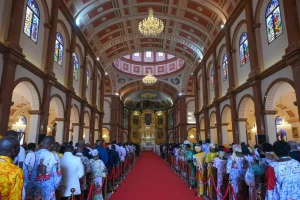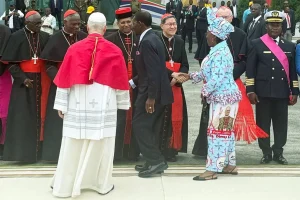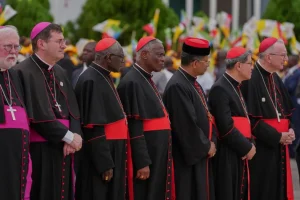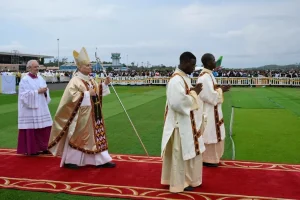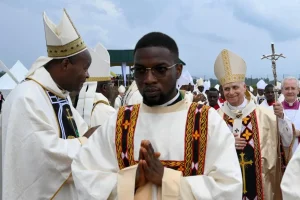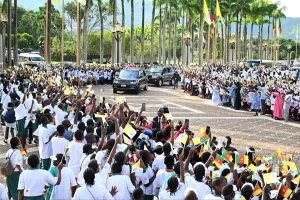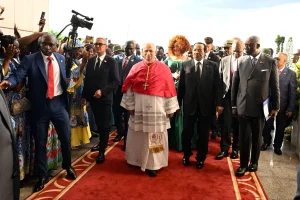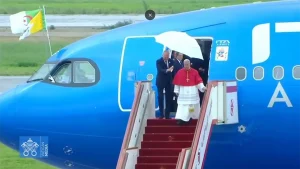
THE motorcade was assembled. The vestments were neatly folded. The diplomatic handshakes had been shaken, the homilies delivered, the open-air Mass at Bamenda’s sweeping outdoor ground had drawn tens of thousands of the faithful, their voices rising into the Cameroonian sky like incense. Pope Leo XIV had done everything the schedule required of him.
He was, as they say in Vatican circles, about to peel off.
And then she came.
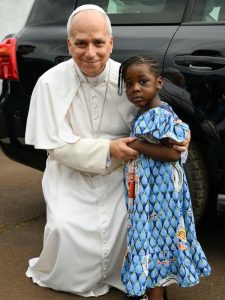
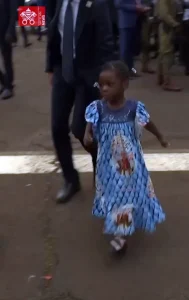
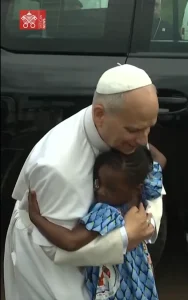
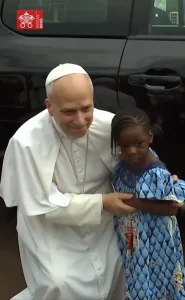
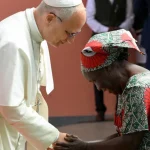
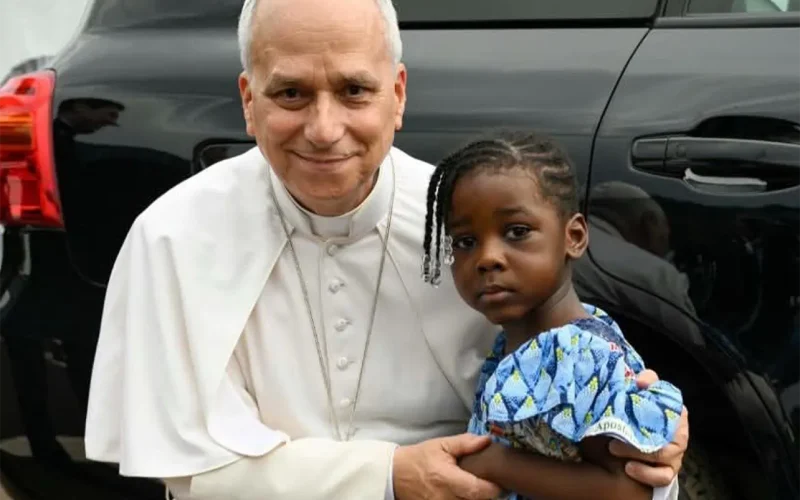
She was small. She was fast. She was wearing a blue floral dress — the kind that catches the afternoon light just so — with her hair braided in the immaculate, intricate architecture that only African mothers and grandmothers have the patience and love to produce at six in the morning before a once-in-a-lifetime event. She broke from the crowd with the singular, fearless purpose that only small children and very old saints possess.
Security detail, we must presume, had a moment.
“The papal motorcade blinked. Heavy security, trained to neutralise threats from heads of state and armed men, found itself entirely outmanoeuvred by a child in a floral dress.”
The papal motorcade blinked. Heavy security, trained to neutralise threats from heads of state and armed men alike, found itself entirely outmanoeuvred by a child in a floral dress with absolutely nowhere else to be and absolutely nothing else on her agenda except this one man, right now.
So they relented. What else could they do?
And Pope Leo XIV — the 267th successor of Peter, the Bishop of Rome, the sovereign of Vatican City, the man who had, in the preceding days, met presidents and archbishops and heads of protocol and chiefs of state with the carefully calibrated gravity of his office — obliged.
The Geometry of Grace
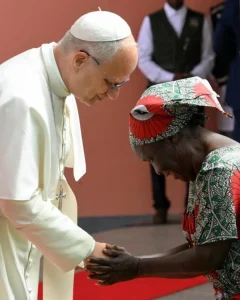
He did not wave from a distance. He did not nod from behind a pane of bulletproof glass. He bent. Pope Leo XIV, head of the universal Catholic Church, bent down to her height — that particular, intimate geometry that every parent knows, that crouch that says:
“You are not too small. I see you.”
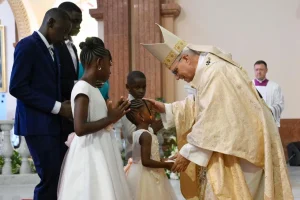
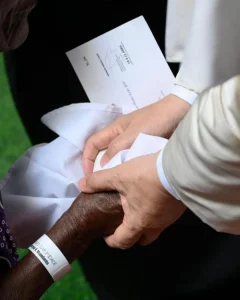
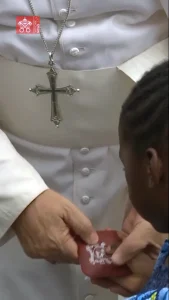
He hugged her. He held still for a photograph — the kind that will outlast every communiqué issued from this visit, every joint statement, every carefully negotiated protocol. And then, in a gesture that belongs more to a grandfather than a pontiff, he reached into the folds of his white vestments — into his pocket, as if he had been carrying it there precisely for this moment — and produced a rosary.
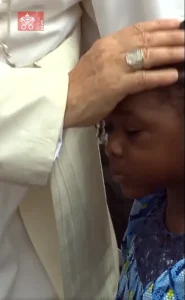
He touched her forehead. Gave her a papal blessing — the full, official, two-thousand-year-old kind.
She received both as if she had been expecting exactly this all along, which, if you believe in such things, perhaps she had.
At the end of Mass in Bamenda on Thursday, as Pope Leo XIV was about to get his car to return to the airport, a little Cameroonian girl ran up to the Pope, and he hugged her, paused for a photo, and gave her a Rosary. pic.twitter.com/GiBD0fD2vq
— Vatican News (@VaticanNews) April 17, 2026
The Protocol That Couldn’t Compete
Somewhere in a filing cabinet in Yaoundé, there is a very thorough document outlining the official programme of Pope Leo XIV’s apostolic journey to Cameroon: the bilateral meetings, the papal Mass, the ecumenical encounters, the address to clergy, the departure ceremony. It is no doubt an impressive document. It required, we must assume, months of coordination between the Vatican Secretariat of State and the Cameroonian government.
None of it will be remembered like this.
There is a reason the Catholic Church has spent two millennia telling this story — the one about not stopping the children, about the kingdom belonging to such as these. It is because every generation needs a fresh, living, unscripted illustration of the point. Bamenda 2026 has just supplied one.
“She received the hug, the photograph, the papal blessing, and a rosary — all without an appointment. Protocol, for once, was simply outrun.”
Africa Gave Him This
Something else is worth noting, quietly but firmly: this moment happened in Africa. Not in the curated splendour of the Vatican gardens. Not on the steps of a European cathedral with a thousand cameras pre-positioned by a communications team. It happened in Bamenda, in the North West Region of Cameroon, in a country still carrying the weight of its own complex history and an ongoing Anglophone crisis that the world has been too busy to properly notice.
And into that complicated, beautiful, unfinished story ran a little girl in a blue floral dress. And the Pope stopped.
Africa is very good at producing these moments — moments that cut clean through the layers of geopolitics and protocol and institutional gravity to reveal something irreducibly human. The continent has been doing this for centuries, though the history books, written elsewhere, have not always paused to notice.
They will notice this one.
The name of the girl in the blue floral dress has not yet been widely reported. That seems, somehow, right. She does not need a name to be historic. She already is. She ran out of a crowd in Bamenda, in her good dress and her beautiful braids, and she reminded the 267th pope — and the rest of us watching — what all of this is actually for.
The rosary she was given will live in a drawer somewhere in Cameroon, possibly wrapped in a cloth, almost certainly shown to every visitor who comes to the house for the next forty years.
The photograph will live everywhere else.